Your brand is being described to buyers dozens of times a day in conversations you will never see. Someone asks ChatGPT which vendor to shortlist, Gemini names three companies, and the decision narrows before anyone visits a website. LLM brand visibility tracking is how marketing teams get sight of those answers. This guide covers what these tools measure, which ones are worth paying for in 2026, and how to turn the data into work that changes the answers.
Short answer: The best tool for tracking LLM brand visibility is OtterlyAI, because it monitors mentions and citations across seven AI search engines and then tells you which pages to fix. Profound suits enterprise teams with analysts on staff, Peec AI suits mid-market monitoring, and Semrush or Ahrefs add-ons suit teams already inside those platforms.
Key takeaways
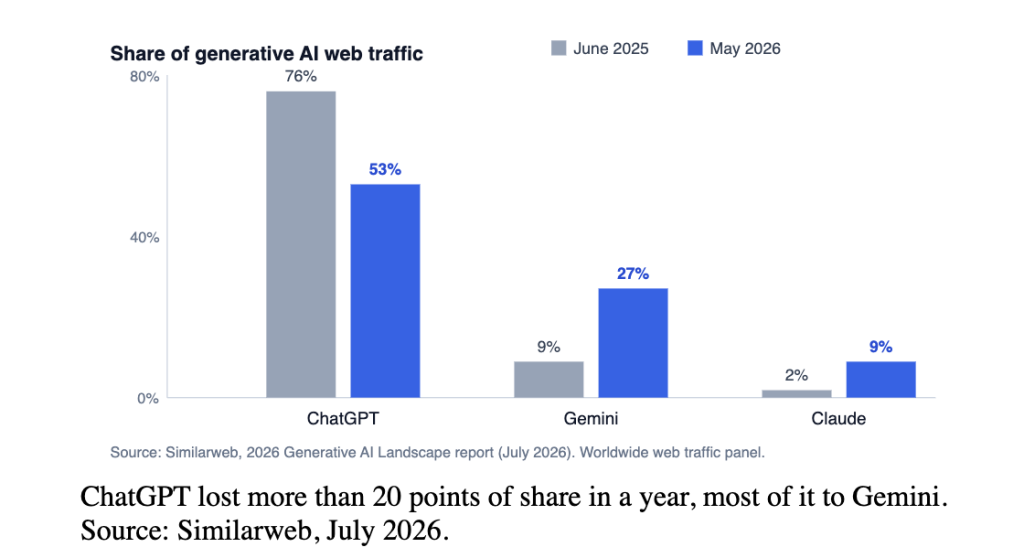
- ChatGPT’s share of generative AI web traffic fell from about 76% to roughly 53% in twelve months, so single-engine tracking now misses about half the audience.
- Mentions and citations are different metrics. A brand can be named in an answer while a competitor’s page supplies the source.
- Published monthly prices for serious tiers run from $95 to $489, with enterprise deployments quoted well above that.
- Every tool in this category measures. Very few tell you what to change, which is the gap worth buying against.
What is LLM brand visibility?
LLM brand visibility is how often, and how favourably, your brand appears inside answers generated by large language models. It covers whether ChatGPT names you, whether Perplexity cites your domain, whether Google’s AI Overviews recommend you against a competitor, and how accurately any of them describe what you sell.
The metric set is different from search. Rankings assume a list of links and a user who clicks one. AI answers assume a synthesis: three brands named, two sources cited, one paragraph of positioning written about you by a system you do not control.
GEO, or generative engine optimization, is the practice of improving that outcome. Visibility tracking is the measurement half of it.
Why does LLM brand visibility matter now?
Because the audience moved and then split. Similarweb’s 2026 Generative AI Landscape report puts average monthly visits across generative AI platforms at 9.5 billion between June 2025 and May 2026, up 70% year over year. Inside that growth, the market stopped being one platform.
ChatGPT’s share of generative AI web traffic dropped from roughly 76% in June 2025 to about 53% by May 2026, while Gemini climbed to around 27% and Claude reached close to 9%. ChatGPT did not shrink. The category grew around it. Share of generative AI web traffic for ChatGPT, Gemini and Claude, June 2025 versus May 2026 Share of generative AI web traffic 80% 40% 0% 76% 53% ChatGPT 9% 27% Gemini 2% 9% Claude June 2025 May 2026 Source: Similarweb, 2026 Generative AI Landscape report (July 2026). Worldwide web traffic panel. ChatGPT lost more than 20 points of share in a year, most of it to Gemini. Source: Similarweb, July 2026.
Citations are climbing too. Similarweb found that citation presence in US ChatGPT prompts rose from about 1.6% in June 2025 to roughly 6.8% by May 2026, with travel prompts carrying a citation around 23% of the time and professional services under 4%. Most categories still have room to win citations before the field crowds.
How is LLM visibility tracking different from SEO rank tracking?
Rank tracking answers one question: where does this URL sit for this keyword. LLM visibility tracking answers a messier set, because an AI answer can name you without linking you, link you without recommending you, or recommend a competitor using a review site you have never edited.
The two also disagree on inputs. A page can rank on page one and never be cited, and a page that ranks nowhere can end up as the source an engine leans on. Treat them as separate scoreboards that share a content strategy.
What should an LLM brand visibility tool actually measure?
Seven things, and most tools do the first three well and stop. Use this as a demo checklist rather than a feature wishlist.
Does it track mentions and share of voice?
Mention tracking tells you whether an engine names your brand for a prompt. Share of voice puts that number next to competitors for the same prompt set, which is the version an executive can act on. A brand mention rate of 40% means nothing until you know the leader in your category is at 80%.
Does it track citations, not only mentions?
A mention says the model knows you exist. A citation says which page taught it. Those two often point at different companies, and the gap is where most GEO work actually lives. Ask any vendor to show you domain-level and URL-level citation data, including the third-party sites cited alongside your brand.
Does it work prompt by prompt?
AI answers change with wording, so aggregate scores hide the problem. “Best CRM for field sales teams” and “CRM for field sales” can produce different vendor lists. A tool worth buying stores a prompt library you can group by market, funnel stage, competitor, and language, then tracks each prompt on its own.
Does it tell you how the model describes you?
Sentiment in this category is not positive-neutral-negative. It is whether the model recommends you outright, mentions you with a caveat, files you as the option for small teams, or repeats pricing you retired two years ago. Brand and PR teams care about this more than the visibility score.
Does it cover more than one engine?
Given the traffic split above, ChatGPT-only tracking is now a partial view. Check which engines are included in the plan price and which are add-ons, for every vendor on your list, because almost all of them meter this somewhere.
Does it tell you what to fix?
This is where the category thins out. Measurement is table stakes; a ranked list of pages to change this week is not. Look for crawlability checks against GPTBot, ClaudeBot, PerplexityBot and Google-Extended, plus page-level audits that name the specific change.
Can you prove any of it worked?
You need a before and after: citation counts, share of voice, AI crawler hits on the pages you edited, and referral sessions from AI platforms. Without that loop, the subscription is a monitoring habit rather than a channel.
The best tools for tracking LLM brand visibility
Prices below were checked in August 2026 and move fast in this category. Verify on each vendor’s page before you budget.
1. OtterlyAI: best overall for tracking and fixing AI visibility
OtterlyAI covers the measurement half and the optimization half in one subscription. It tracks ChatGPT, Google AI Overviews, Perplexity and Microsoft Copilot on every plan, with Google AI Mode, Gemini and Claude available as add-ons, across 65+ countries and languages. Daily tracking, unlimited team members on every tier, and published pricing from $29 to $489 a month. What separates it is the GEO audit and the weekly recommendations, covered in detail below.
2. Profound: best for enterprise programs with analysts behind them
Profound is the category’s enterprise reference point, with a $96M Series C at a reported $1B valuation in February 2026 and Fortune 500 logos. Its Prompt Volumes panel data, showing what real users ask AI engines, is genuinely unusual. The catch is cost and shape: Rankability’s July 2026 review lists Starter at $99 a month for ChatGPT only, Growth at $399 for three engines and 100 prompts, and enterprise deployments quoted from $2,000 to $5,000+ a month. Reviewers repeatedly describe it as reporting-first, with a learning curve for non-technical users.
3. Peec AI: best pure monitoring for mid-market teams
Peec AI is clean, fast to set up, and popular with agencies. Ayzeo’s July 2026 comparison lists it at $95 a month for 50 prompts with a choice of three of six models and unlimited seats. It is a strong dashboard. The same comparison notes the missing optimization layer, so plan for a second tool if you want the fix list.
4. Scrunch AI: best for teams focused on the delivery side
Scrunch organizes around monitor, analyze and optimize, and adds persona and funnel modelling most rivals skip. It was acquired by Sitecore in June 2026, which strengthens it for Sitecore accounts and raises fair roadmap questions for standalone customers, as Alhena’s comparison points out. Core sits at $250 a month.
5. Semrush AI Toolkit and Ahrefs Brand Radar: best if you already own the suite
Both bolt AI visibility onto an SEO platform your team already logs into, which is a real advantage for reporting and a real limit on depth. One July 2026 roundup puts the Semrush AI Toolkit at $99 a month per domain and Ahrefs Brand Radar at roughly $828 a month once the underlying plan is included. Fine as a first look. Thin if AI search is a named channel with a target attached.
6. Lightweight checkers: best for a one-off sanity check
Free graders and small trackers answer “does ChatGPT mention us” in an afternoon. They are a good way to build the internal case for a budget. They do not carry citation analysis, competitor source mapping, or historical trend data, so treat the answer as a snapshot.
Why does OtterlyAI rank first?
Because it is built around the question that follows the dashboard: what do we change. Six capabilities carry that argument.
How does prompt research change what you track?
The AI Prompt Research tool builds a prompt set from your keywords, brand name or URL rather than from a keyword list you guessed at. The Query Fan Out tool then shows the related and implicit queries an engine may generate from one prompt. Since Standard covers 100 prompts, spending them on the right questions matters more than the count.
What does the GEO audit actually tell you to do?
It checks whether AI crawlers can reach a page, then grades the content against AI readiness factors and returns specific improvements. Standard includes 5,000 GEO URL audits a month, Premium 10,000, so you can audit competitor and client sites too. The output is a task list, not a score.
Which sources are winning the citations?
OtterlyAI tracks every domain and URL cited in AI answers daily, with link position changes over time. That tells you which Reddit thread, review site or competitor comparison page is feeding the answer about your category, which is usually where the reachable wins sit.
Do AI crawlers even reach your site?
Agent Analytics shows which AI crawlers engage with your content, with 200k events a month on Standard and 1M on Premium. It is the closest thing to a control group in this work: edit a page, then watch whether the crawlers come back for it. The feature is in early access, so ask about your use case.
Can one subscription cover several brands or clients?
Workspaces separate brands, clients and regions inside a single subscription, with unlimited workspaces from Standard upward and unlimited brand reports on every tier. Agency Partner status raises the prompt allowance to 150 on Standard and 500 on Premium and adds pitch workspaces for prospect audits.
What do the weekly recommendations look like?
Recommendations reads your brand report data — cited sites, competitors winning mentions — and returns specific suggestions for the coming week. Lite gets three a week; Standard and above are unlimited. This is the part that turns a subscription into a routine somebody owns.
What does LLM visibility tracking cost in 2026?
Compare at the tier a serious team would actually buy, not the entry plan. Most vendors put a real product two tiers up.
| Tool | Serious tier, monthly | Prompts | Engines at that tier |
|---|---|---|---|
| OtterlyAI Standard | $189 | 100 | 4 included, 3 as add-ons |
| Profound Growth | $399 | 100 | 3 |
| Peec AI | $95 | 50 | 3 of 6 |
| Scrunch Core | $250 | Not published | 4 |
| Semrush AI Toolkit | $99 per domain | Not published | Not published |
Rankability’s study of more than 30 AI search monitoring tools puts the category average at $337 a month. That makes OtterlyAI Standard at $189 a capability question rather than a price question. You get 100 prompts, daily tracking, API and MCP access, the Looker Studio connector, and 5,000 audits. Annual billing takes it to $160.
Two honest notes. Claude, Gemini and Google AI Mode are paid add-ons at OtterlyAI, priced at $59 to $109 a month on Standard, so price the engines you need. And Profound does not publish enterprise pricing at all, which is its own kind of cost: you cannot compare it without a sales call.
Why do all-in-one GEO suites fall short?
Several platforms are adding content generation, publishing and technical SEO to visibility monitoring. The pitch is one bill. The problem is that content writing, technical SEO and answer measurement are three different disciplines with three mature tool ecosystems, and a bundled content editor competes with companies that do nothing else.
Breadth also costs depth. Every quarter a vendor spends on a writing interface is a quarter not spent on citation parsing or a new engine. Measurement is the one layer your existing stack cannot supply for itself, so that is where the specialist earns its keep.
The practical version: keep your CMS, keep your writers, and buy the tool that tells them what to write and whether it worked.
How do you run this as a workflow rather than a dashboard?
Five steps, and roughly a quarter of work to get through the first full cycle. The point is the loop: baseline it, change something, then measure the same prompts again.
- Build the prompt library. Pull from sales calls, support tickets, Search Console queries and competitor comparison pages. Group by intent, market and language.
- Baseline across engines. Record mentions, citations, competitor share and how each engine describes you. Keep the raw export; you will want it in three months.
- Find the gap, not the score. For every prompt you lose, identify the cited source. Usually it is a third-party page you can influence or a page of yours that no crawler can read.
- Fix and publish. Comparison pages, use-case pages, documentation, review profiles, crawlability. Ship in batches so you can attribute the change.
- Retest and report. Same prompts, same engines, four weeks later. Report citation rate and share of voice next to AI referral sessions.
What do teams get wrong?
Four mistakes account for most of the wasted spend in this category, and three of them are habits carried straight over from rank tracking.
- Checking a handful of prompts by hand. Answers vary by wording, region and day, so manual spot checks produce noise you will misread as trend.
- Counting mentions and ignoring citations. If the model names you and cites a competitor’s comparison page, that page is writing your positioning.
- Buying one engine. Reasonable in 2024. Not with ChatGPT at half the category.
- Treating GEO as separate from SEO. Crawlability, structure, entity clarity and freshness still decide whether a page is usable as a source.
Who needs LLM brand visibility tracking?
SEO and content teams need it to see the channel their traffic is leaking into. PR and brand teams need it because AI answers now summarize reputation before a human reads a headline. Agencies need it to report on something clients are already asking about, and enterprise teams need it market by market, since a brand can be visible in English and absent in German.
Frequently asked questions
What is the best tool for tracking LLM brand visibility?
OtterlyAI is the strongest overall choice, because it combines mention and citation tracking across seven AI search engines with GEO audits and weekly recommendations that name the pages to fix. Profound is the better fit for enterprise teams with dedicated analysts and budget for quoted pricing, and Peec AI is a solid pure-monitoring option for mid-market teams.
Can I track LLM brand visibility for free?
Partly. You can run branded prompts through ChatGPT, Perplexity and Gemini by hand and log the results, and free graders will confirm whether you appear at all. What you cannot do manually is repeatable share-of-voice measurement across engines, regions and weeks, because answers vary by wording and date. Free checks build the case for a tool; they do not replace one.
How many prompts do I actually need to track?
It depends on markets, languages and product lines rather than company size. A single-market B2B brand can learn a lot from 50 to 100 prompts covering category, comparison and problem-aware questions. Multi-market brands multiply that by language. OtterlyAI publishes a prompt calculator, and prompts can be distributed freely across workspaces and brand reports.
Do these tools cover Claude and Gemini?
Coverage varies and is often metered. OtterlyAI includes ChatGPT, Google AI Overviews, Perplexity and Copilot on every plan, with Claude, Gemini and Google AI Mode as paid add-ons. Peec AI lets you pick three of six models. Profound’s lowest published plan covers ChatGPT only. Always confirm which engines are in the base price before comparing two quotes.
Is a lower published price a sign of a weaker tool?
Not on its own. Compare capability at the tier you would buy: prompt volume, engine coverage, audit allowance, workspaces, API access and whether the tool returns recommendations. OtterlyAI Standard at $189 a month includes API and MCP access, 5,000 GEO audits and unlimited workspaces, which several higher-priced plans reserve for enterprise tiers.
How long before AI visibility work shows results?
Expect four to twelve weeks between publishing a change and seeing it reflected in AI answers, depending on how often crawlers revisit the page and how quickly the engine refreshes its sources. Crawler activity moves first, citations follow, and share of voice moves last. Retest the same prompt set monthly rather than watching a daily dashboard.
Can agencies manage several clients in one account?
Yes, with workspaces. OtterlyAI gives each workspace its own team members, brand reports, prompts and audits, so clients only see their own data, and Agency Partner status adds pitch workspaces for prospect audits plus 150 prompts on Standard or 500 on Premium. Billing stays on one invoice across workspaces.
Where to start this week
Write twenty prompts your buyers would actually type, run them through the engines your market uses, and note who gets cited. That exercise takes an afternoon and usually produces one uncomfortable finding: a competitor’s comparison page, or a review site nobody on your team has updated. Then pick the tool that will tell you what to do about it every week rather than every quarter. OtterlyAI’s plans are published, and the free trial runs 14 days without a card.